
Blog
How Fabric Choice Affects Embroidery Quality and Stitch Performance

Embroidery quality depends on far more than a well-digitized design and a high-quality embroidery machine. One of the most important factors that directly affects stitch quality, design appearance, durability, and production efficiency is the fabric being embroidered.
Different fabrics react differently during the embroidery process. A design that stitches perfectly on a structured cotton polo may produce distortion, puckering, or poor coverage on a lightweight performance shirt if the digitizing and stabilization are not adjusted accordingly.
Understanding how fabric characteristics influence embroidery performance is essential for achieving professional results. Whether you’re embroidering corporate uniforms, promotional apparel, sportswear, hats, jackets, or fashion garments, selecting the right fabric and optimizing the embroidery file accordingly can dramatically improve stitch quality and production efficiency.
In this guide, we’ll explore how fabric choice impacts embroidery quality, the challenges associated with different fabric types, and the techniques professional digitizers use to create embroidery files that perform successfully on various materials.
Why Fabric Matters in Embroidery
Embroidery involves repeatedly penetrating fabric with a needle while placing thousands of stitches into the material.
Every fabric responds differently to:
- Needle penetration
- Thread tension
- Stitch density
- Underlay stitches
- Hoop pressure
- Machine speed
As a result, the same embroidery design may produce completely different results depending on the fabric being used.
Professional embroidery digitizers always consider fabric type before creating or adjusting an embroidery file.
How Fabric Affects Stitch Performance
Fabric influences several important aspects of embroidery quality.
Design Stability
Some fabrics remain stable during embroidery, while others stretch and shift.
Unstable fabrics can cause:
- Distorted logos
- Misaligned elements
- Registration issues
- Uneven lettering
Stitch Coverage
The texture and weave of a fabric affect how well stitches cover the surface.
Certain fabrics allow stitches to sit neatly on top, while others cause stitches to sink into the material.
Thread Tension Response
Different fabrics react differently to embroidery tension.
Improper tension settings may lead to:
- Thread breaks
- Puckering
- Loose stitches
- Distorted designs
Design Appearance
Fabric texture plays a major role in the final appearance of embroidery.
Smooth fabrics often produce crisp embroidery, while textured fabrics may reduce detail visibility.
Understanding Fabric Stability
One of the most important considerations in embroidery digitizing is fabric stability.
Stable Fabrics
Stable fabrics maintain their shape during embroidery.
Examples include:
- Twill
- Denim
- Canvas
- Structured cotton
These materials are generally easier to embroider because they resist stretching and distortion.
Unstable Fabrics
Unstable fabrics move more during embroidery.
Examples include:
- Performance fabrics
- Polyester knits
- Stretch garments
- Athletic apparel
These fabrics require specialized digitizing techniques to prevent distortion and puckering.
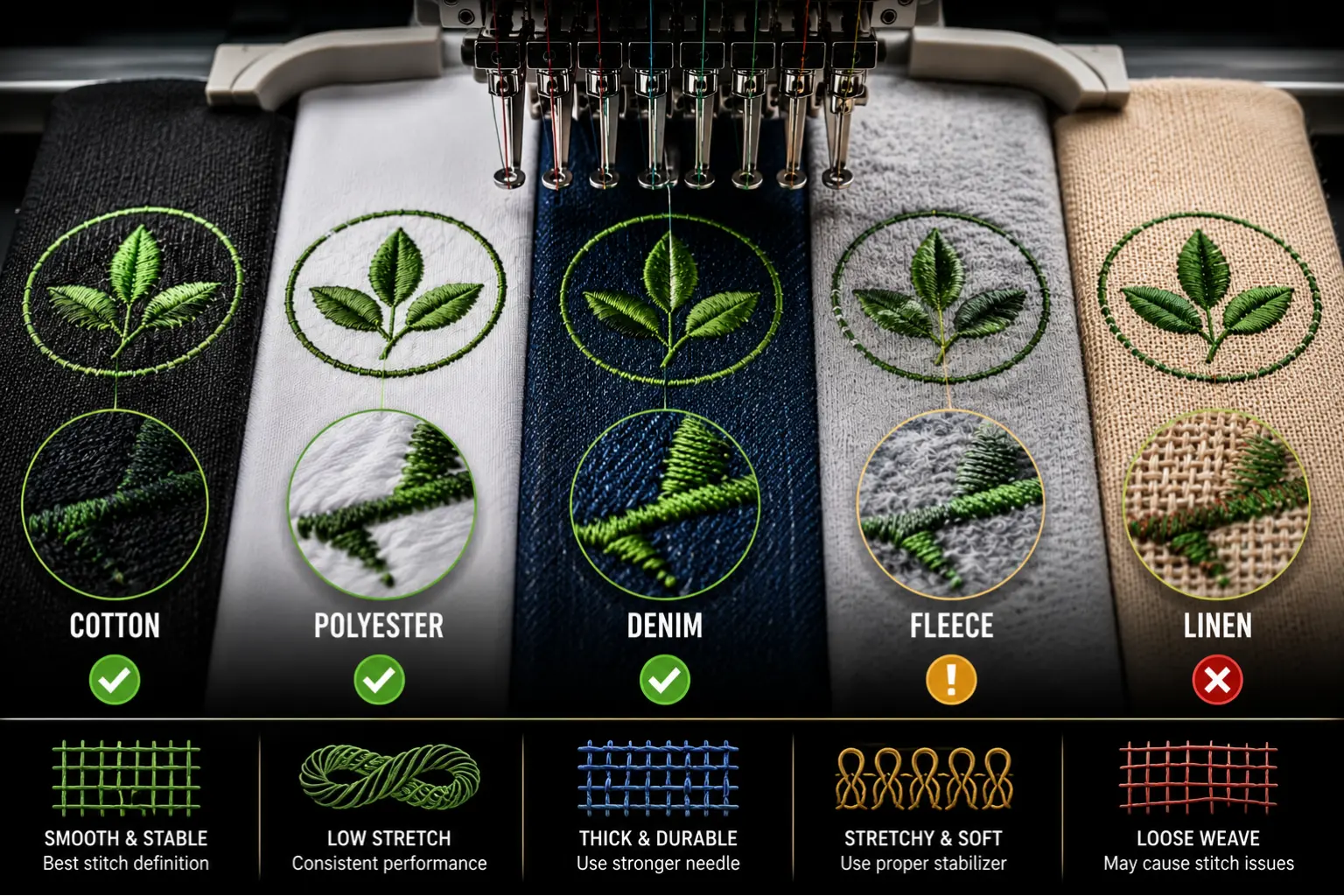
Embroidery on Cotton Fabrics
Cotton remains one of the most popular fabrics for embroidery.
Advantages of Cotton
- Stable surface
- Excellent stitch definition
- Good thread support
- Versatile applications
Cotton is commonly used for:
- Polo shirts
- T-shirts
- Uniforms
- Promotional apparel
Challenges of Cotton
Although cotton performs well overall, lightweight cotton fabrics can still experience:
- Puckering
- Design distortion
- Fabric movement
Proper stabilization remains important even with stable cotton materials.
Embroidery on Polyester Fabrics
Polyester is widely used in modern apparel, especially performance clothing.
Advantages of Polyester
- Durable
- Moisture resistant
- Wrinkle resistant
- Lightweight
Embroidery Challenges
Polyester can create several embroidery difficulties:
- Fabric stretching
- Distortion
- Heat sensitivity
- Dye migration
Dye migration occurs when garment dyes bleed into embroidery thread, particularly on dark-colored polyester garments.
Professional digitizers often adjust density and underlay to compensate for polyester’s unique behavior.
Embroidery on Performance Fabrics
Athletic and performance garments continue to grow in popularity.
These fabrics are often made from:
- Polyester blends
- Moisture-wicking materials
- Stretch fabrics
Common Challenges
Performance fabrics may:
- Stretch excessively
- Distort during stitching
- Show puckering
- Require specialized stabilizers
Digitizers frequently use lighter stitch densities and carefully optimized underlay structures for these garments.
Embroidery on Denim
Denim is a highly durable fabric that supports embroidery exceptionally well.
Benefits of Denim
- Excellent stability
- Strong stitch support
- Minimal distortion
- Durable finished embroidery
Denim is commonly used for:
- Jackets
- Jeans
- Workwear
- Fashion apparel
Considerations
Because denim is thick, needle selection becomes particularly important to ensure smooth embroidery operation.
Embroidery on Canvas
Canvas is one of the easiest materials to embroider.
Advantages
- Extremely stable
- Excellent stitch support
- Minimal stretching
- Consistent results
Canvas is commonly used for:
- Bags
- Totes
- Promotional products
- Outdoor products
Professional embroidery files generally perform very well on canvas surfaces.
Embroidery on Fleece
Fleece presents unique embroidery challenges because of its soft, textured surface.
Common Problems
- Stitches sinking into fabric
- Reduced detail visibility
- Uneven lettering
Solutions
Professional embroiderers often use:
- Water-soluble topping
- Enhanced underlay
- Increased stitch coverage
These techniques help maintain clean embroidery on fleece garments.
Embroidery on Knit Fabrics
Knits are among the most challenging materials for embroidery.
Examples include:
- T-shirts
- Stretch apparel
- Athletic wear
- Fashion garments
Common Issues
Knit fabrics may experience:
- Stretching
- Distortion
- Puckering
- Misalignment
Professional digitizers frequently reduce density and apply specialized compensation techniques when digitizing for knits.
How Fabric Influences Stitch Density
Stitch density refers to how closely stitches are placed together.
The ideal density depends heavily on fabric type.
Stable Fabrics
Stable fabrics can generally support:
- Higher density
- Greater stitch coverage
- More detailed embroidery
Lightweight Fabrics
Lightweight materials often require:
- Reduced density
- Less stitch buildup
- Careful stitch sequencing
Excessive density on lightweight fabrics commonly causes puckering and distortion.
The Role of Underlay Stitches
Underlay stitches form the foundation of embroidery.
Fabric type directly influences underlay selection.
Benefits of Proper Underlay
- Fabric stabilization
- Improved stitch coverage
- Better edge definition
- Reduced distortion
Different fabrics often require different underlay combinations to achieve optimal results.
Pull Compensation and Fabric Behavior
During embroidery, stitches naturally pull fabric inward.
This effect is known as pull.
Different fabrics react differently to pull forces.
Stretch Fabrics
Stretch materials often require greater pull compensation to maintain accurate design dimensions.
Stable Fabrics
Stable fabrics generally require less compensation.
Professional digitizers adjust compensation settings based on fabric characteristics to ensure design accuracy.
Fabric Texture and Design Detail
Fabric texture significantly affects embroidery appearance.
Smooth Fabrics
Smooth fabrics provide:
- Better detail visibility
- Cleaner lettering
- Sharper logos
Textured Fabrics
Textured materials may reduce:
- Fine detail visibility
- Small text readability
- Edge definition
Design simplification may be necessary for highly textured fabrics.
Choosing the Right Stabilizer for Different Fabrics
Stabilizers play a critical role in embroidery quality.
The correct stabilizer depends largely on fabric type.
Cut-Away Stabilizers
Best for:
- Stretch fabrics
- Knits
- Performance apparel
Tear-Away Stabilizers
Best for:
- Stable woven fabrics
- Cotton garments
- Structured apparel
Wash-Away Stabilizers
Best for:
- Delicate applications
- Specialty embroidery
Using the proper stabilizer greatly improves stitch performance and design stability.
Common Fabric-Related Embroidery Problems
Puckering
Occurs when fabric contracts around dense stitching.
Design Distortion
Often caused by stretching or improper stabilization.
Poor Coverage
Results from insufficient density or fabric texture interference.
Thread Breaks
Can occur when fabric and digitizing settings are not properly matched.
Sinking Stitches
Common on fleece and textured materials.
Understanding these issues helps embroiderers select appropriate solutions before production begins.
Why Fabric Information Matters for Digitizing
One of the most valuable pieces of information customers can provide to a digitizer is the intended fabric type.
Knowing the fabric allows digitizers to optimize:
- Stitch density
- Underlay
- Pull compensation
- Stitch types
- Design structure
Without fabric information, even a professionally digitized file may not perform optimally.
Best Practices for Embroidering Different Fabrics
To achieve the highest embroidery quality:
- Identify the fabric before digitizing
- Use appropriate stabilizers
- Select correct needle types
- Adjust stitch density accordingly
- Test designs before production
- Optimize underlay structures
- Apply proper pull compensation
These practices significantly improve stitch quality and reduce production issues.
How Professional Digitizing Improves Fabric Compatibility
Professional embroidery digitizers do not create one-size-fits-all embroidery files.
Instead, they customize embroidery settings based on:
- Fabric type
- Garment construction
- Design complexity
- Production requirements
This customized approach helps ensure consistent embroidery quality across a wide range of materials.
Final Thoughts
Fabric choice plays a crucial role in embroidery quality and stitch performance. Different fabrics react differently to needle penetration, stitch density, thread tension, and underlay structures, making fabric selection one of the most important considerations in professional embroidery.
Whether you’re embroidering cotton polos, polyester performance wear, denim jackets, fleece garments, or canvas products, understanding how fabric affects embroidery allows you to achieve cleaner stitches, better design clarity, improved durability, and more efficient production.
At MAS Digitizing, we create fabric-specific embroidery files optimized for the unique characteristics of each garment, helping businesses and embroidery professionals achieve exceptional embroidery quality on every project.